
















Spine Plus Blog
Basic Daily Back and Core Exercise Routine
Published: 26 January 2020

Designed and prepared by Robert Shanks, BSc (Hons) Ost, Director of spineplus.co.uk and injuryfitpro.com, and author of the book Back Pain Decoded, available from injuryfitpro.com and Amazon.
The following exercises focus on true core stability: engaging the core muscles to stabilise the spine rather than produce movement. This approach reduces injury risk compared to traditional exercises like crunches and oblique twists, which load the spine under flexion.
Disclaimer: These generic exercises are not a substitute for personalised professional consultation. Stop any exercise that causes pain and seek guidance.
Exercise 1: Perfect Posture Heel Slides
1 to 2 sets of 10 reps each side. Lie on your back with knees bent, maintaining a neutral spine. Engage your core through pelvic floor and transverse abdominis activation. While breathing steadily, extend one leg by sliding the heel outward, then return to the starting position. Alternate legs while keeping the back neutral throughout.
Exercise 2: Hip Twist (Bent Knee Fall Out)
1 to 2 sets of 10 reps each side. From supine with bent knees and neutral lower back, engage core muscles. Open one leg to the side while maintaining stability in the lower back and opposite leg. Return to centre and repeat on the other side.
Exercise 3: Glute Bridge on Heels
1 to 2 sets of 10 reps. Lie on your back with bent knees. Lift forefoot and press heels down. Squeeze buttocks and lift hips to form a straight line with your body, then lower slowly.
Exercise 4: Cat and Dog Stretch
1 set of 7 reps. Start in quadruped position. For the dog stretch, inhale and allow belly to drop while arching the back and extending the head. For the cat stretch, exhale while rounding the back and tucking the chin. Alternate smoothly between positions.
Exercise 5: Threading the Needle (Thoracic Mobility)
1 set of 6 reps each side. In quadruped position, reach one arm under your body, then rotate your trunk to raise that hand toward the ceiling. Progress range of motion gradually while keeping knees planted.
Exercise 6: Modified Bird Dog
1 to 2 sets of 10 reps each side. Place elbows on a table or countertop with feet on the ground. Set neutral spine and tuck chin. Tighten abdominals. Lift one arm and the opposite leg without allowing trunk or pelvis movement, then lower and repeat on the other side.
Exercise 7: Side-Bridge on Shoulder
1 to 2 sets of 10 reps each side. Lie on your side with feet on a small step and head supported. Lift hips upward and hold in a straight position parallel to the ground.
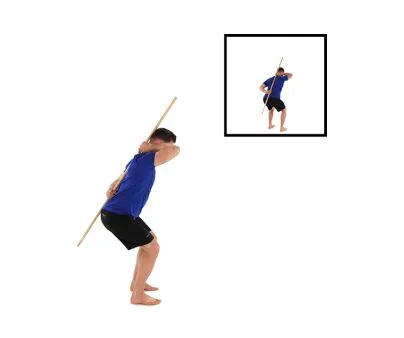
Exercise 8: Mini Squat Broomstick Hip Hinge
1 to 2 sets of 10 reps. Stand with feet hip-width apart. Position a stick behind your back with three contact points: back of head, mid-back, and tailbone. Bend knees into a mini squat while hinging at the hips, maintaining all three contact points throughout.
Exercises for Lower Back Pain
This exercise routine has been designed to help rehabilitate patients with back pain, and also for anyone seeking a core workout that improves core strength and tones the midsection while helping to decrease back pain injury risk. Traditional gym-style core exercises such as crunches, oblique twists, reverse crunches and side bends involve movement of the trunk and lower back vertebrae. Repetitive flexion and rotation movements like these have been shown in some studies, including those of Professor Stuart McGill, to increase wear and tear and injury risk to the lumbar discs. The exercises above mostly involve true core stability exercises that engage the core muscles to prevent rather than produce movement of the lower back, i.e. to stabilise it. This style of exercise is associated with reduced injury risk, so these are arguably the best ab exercises to include in a workout. Some articulatory movement of the spine is still necessary to promote symmetry of movement and circulation, which is covered by Exercises 4 and 5 above.
Acknowledgement: the exercise images referenced in this routine are drawn from our software subscription to Physiotec.org, which enables bespoke exercise prescription and video illustrations for our clients. For your own bespoke rehab exercise programme, get in touch with one of our clinics.
Medical disclaimer: every effort has been made to set out safe, industry-recognised exercises. If any of these exercises cause pain or exacerbate symptoms, stop and seek professional advice. This generic advice cannot be 100% complete, safe and effective for every individual; each person's symptoms, injury and recovery vary depending on medical history, posture, genetics, motivation and application. These exercises are no substitute for a one-to-one consultation with an appropriately qualified healthcare professional.