
















Spine Plus Blog
Facet Joint Pain
Published: 19 February 2015

Facet joints are small joints along the spine's posterior aspect, with two per vertebral level. They guide spinal movement and bear approximately 20% of body weight, with the disc and vertebral body handling the remaining 80%.
How Facet Joints Become Painful
Pain can develop through direct trauma or gradual biomechanical imbalances. Common contributing factors include:
- Weak abdominal and core muscles
- Tight back muscles pulling on the facet joints
- Excessive anterior pelvic tilt from tight hip flexors
- Internal rotation of the legs, often caused by excessive foot pronation, which can also drive anterior pelvic tilt
- Leg length discrepancies and scoliosis creating asymmetric loading
- Disc degeneration causing micro-instability that increases facet load
In the neck, facet joint loading is associated with an excessive forward head posture, which causes excessive cervical lordosis (arching) in the middle of the neck. In the lower back, an excessive inward curve places disproportionate load on the facet joints, increasing wear and tear.
Once inflamed, facet joints create a cycle: inflammation causes muscle guarding and stiffness, restricting movement and increasing pressure on the joint, which predisposes it to further arthritis. Facet joints are synovial joints, just like the hip and knee. The health of the cartilage inside the joint depends on proper lubrication with synovial fluid, which normal movement promotes.
Symptoms
The defining characteristic of facet pain is discomfort that is aggravated by backward bending (extension) and relieved by bending forward (flexion). An acute "facet lock" involves jamming of a single joint, producing sharp, stabbing localised pain that severely limits movement. Chronic facet hypertrophy causes a deep, nagging pain slightly to the side of the spine, potentially radiating to the upper leg, buttock, shoulder, or upper arm.
The articulation of facet joints during walking can also aggravate symptoms. Facet joint hypertrophy is a common finding as people get older, and can be symptom-free for many years before becoming painful.
Treatment
Facet lock symptoms usually improve with about a week's rest, but spinal manipulation is usually very successful, providing near-instant relief and helping to unjam the joint and fully restore movement and alignment.
Chronic facet pain may improve with a bespoke management plan addressing the underlying cause, including:
- Corrective postural and core muscle strengthening
- Orthotics and heel lifts to address foot biomechanics and leg length discrepancy
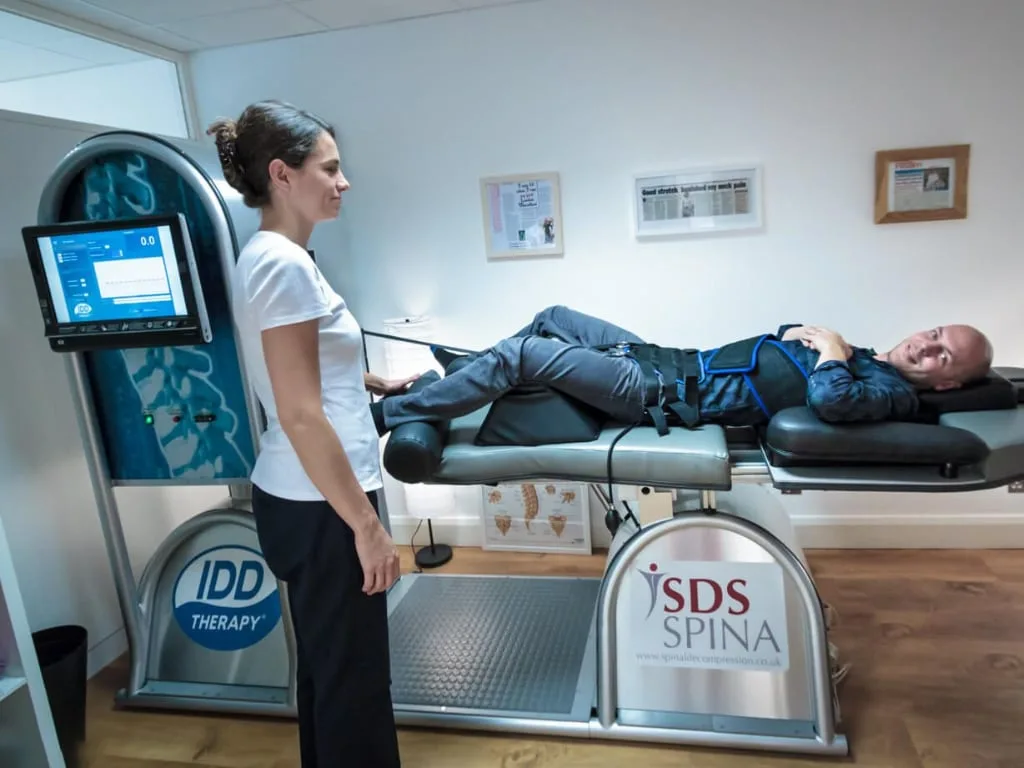
- IDD Spinal Decompression Therapy, where facet pain is secondary to disc degeneration
- Dry needling to the deep paraspinal muscles and facet joint surfaces to reduce trigger point irritability and promote blood flow. This differs from traditional acupuncture, since the paraspinal muscles in the lower back are usually at least 1.5 inches thick, so needles shorter than 50mm typically won't reach deep enough to be effective
- Stretching, deep massage and spinal mobilisation to reduce stiffness and improve range of movement, especially into flexion
Occasionally more invasive intervention is needed. We'd encourage patients to seek x-ray guided facet joint injections from a pain doctor or interventional radiologist. If this helps, it can be repeated, though often with diminishing returns. If injections do confirm the facet joint as the cause of the pain, the patient may be a candidate for Facet Joint Nerve Rhizolysis (Radio Frequency Denervation), which uses radiofrequency energy to ablate the nerves supplying the joint for longer-lasting relief.
In severe cases that don't respond to physical or injection therapy, spinal surgery is the next appropriate step.
Call us on 020 8506 1000 to discuss facet joint pain assessment.