
















Spine Plus Blog
MRI Points the Way
Published: 13 February 2020
Jon came to us on the recommendation of a family member, after years of chronic lower back pain. He'd seen multiple therapists who told him his hips and pelvis were misaligned. Spinal manipulation had become progressively less effective at easing a constant ache in his lower back, and he was experiencing spasms and episodes of his back "locking up" with increasing frequency.
What the MRI Showed
Jon did not have shooting pains down his legs, and clinical signs did not indicate any trapped nerves (radiculopathy). Despite this, we suspected one or two degenerative discs in the lower spine, confirmed by MRI. His report noted: "Extensive Modic type 1 change L5-S1. Lower three motion segments show facet OA. Left paracentral annular tear L4-5 and right paracentral annular tear L5-S1. (No significant nerve root impingement)." On review of the images we also noted slight signs of instability (dynamic retrolisthesis) of his L5 vertebra.
The findings matched the clinical picture: hypermobile L4/5 and L5/S1 segments with stiffness higher up, concentrating stress in the lower discs. This explained why manipulation had been progressively less useful, and more importantly, why it could have been making things worse by increasing motion at already unstable segments. Continuing to manipulate the area risked making things worse: repeated joint clicking would likely make his ligaments even more lax, making his already degenerative discs even more unstable.
MRI-Led Treatment
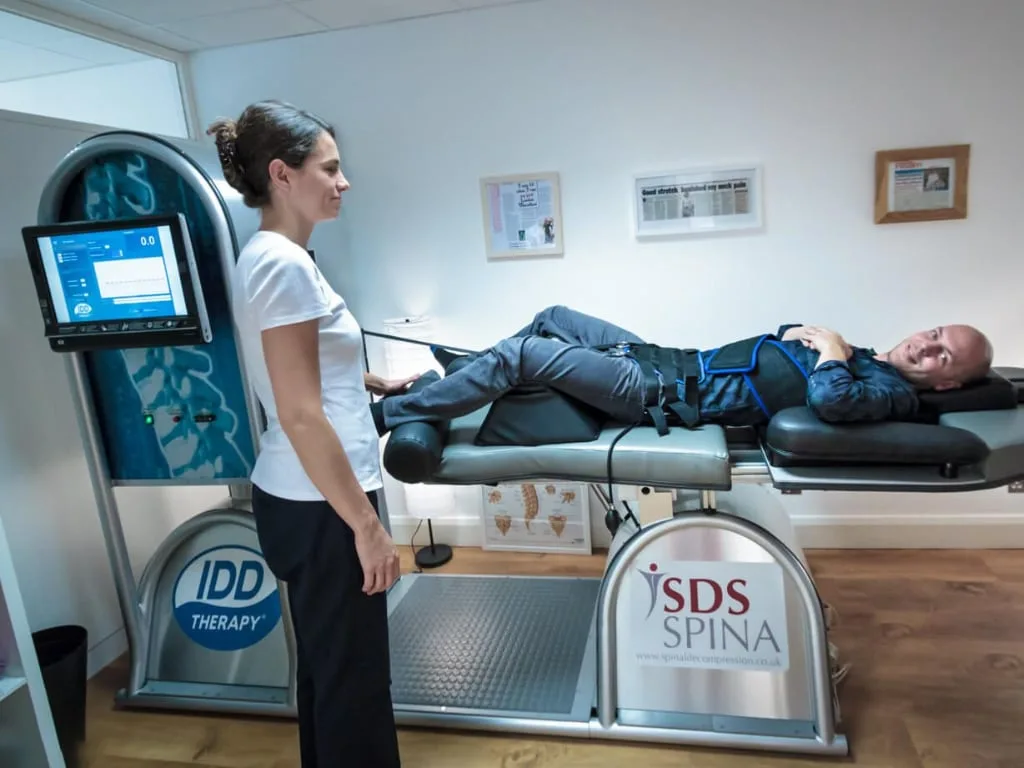
With clear imaging, treatment could be properly targeted. Spinal manipulation was stopped. The treatment programme included IDD Therapy for direct disc decompression, medical acupuncture to reduce muscle tension and spasm, core stabilisation exercises focused on the hypermobile lower segments, and prolotherapy administered by a well-known sports doctor with an excellent reputation working with top athletes. He used P2G prolotherapy (Phenol, Glycerol and Dextrose), a treatment associated with upregulation of fibroblast growth factors that results in stronger, stiffer ligament tissue.
Outcome
After 12 to 24 months of consistent treatment and rehabilitation, Jon regained function and returned to playing football without back spasms. He avoided surgery.
If you have long-standing back pain with an unclear cause, an MRI is often the key to identifying the right treatment. Call us on 020 8506 1000 to discuss a referral.