
















Spine Plus Blog
Neck Exercises for Cervical Disc and Facet Problems
Published: 26 January 2020

Designed and prepared by Robert Shanks, BSc (Hons) Ost, co-founding director of Spine Plus and author of Back Pain Decoded, available from Amazon and injuryfitpro.com. Robert has been involved in the fitness and physical therapy industry for over 20 years.
Important: These exercises are not a substitute for personal, one-to-one consultation with an appropriately qualified healthcare professional. Stop any exercise that causes pain and seek professional guidance from an osteopath or physiotherapist.
The following programme addresses three essential elements for cervical spine health: strengthening the deep neck muscles for stability, maintaining flexibility, and promoting correct posture to prevent undue wear on cervical structures.
Strengthening the deep muscles that support the cervical vertebrae is an essential part of any neck pain rehabilitation or prevention programme. Multiple studies have shown the importance of Longus Colli in particular, and its role in joint position sense (proprioception) and neck stability.
Strengthening on its own is not enough, though. Without attention to posture and alignment, isolated neck exercises tend to lead to undue wear and tear on the ligaments, joints and discs of the cervical spine. Equally, if the muscles and joints of the neck are allowed to become stiff and inflexible, that is not only a source of pain in itself but also makes injury more likely. Strength, flexibility and posture have to be worked on together.
Exercise 1: Deep Cervical Flexor (Longus Colli) Exercise
2 sets of 10 reps with 5-second holds. Lie on your back with knees bent and a rolled towel under the neck. Perform a gentle head flexion like a nodding motion while keeping the back of the head in contact with the surface. This activates the deep stabilising muscles of the cervical spine without loading the superficial muscles.
Exercise 2: Isometric Neck Rotation
2 sets of 10 reps with 10-second holds. Seated or standing with a straight back and chin slightly tucked. Place your hand against the side of your head and gently attempt to rotate while your hand provides equal resistance, so no movement occurs. Hold the contraction, then relax and repeat.
Exercise 3: Isometric Neck Side Bending
2 sets of 10 reps with 10-second holds. Sitting or standing tall with chin tucked. Place fingertips against the side of your head and attempt to side-bend while resisting with your hand. Hold the contraction without allowing any movement.
Exercise 4: Lying Head Rotation
1 set of 6 reps per side. Lie on your back with pillow support. Perform gentle, pain-free rotations, coordinating with breathing. Only rotate within a pain-free range.
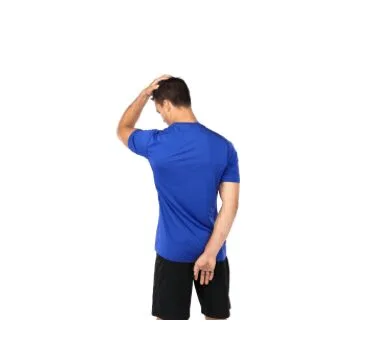
Exercise 5: Upper Trapezius and Levator Scapulae Stretch
2 sets of 1 rep with 20 to 30 second holds. Sitting, reach one arm behind your back to lower the shoulder while rotating the head to the opposite side and gently side-bending away. Hold for 20 to 30 seconds and release slowly.
Why segmental neck health matters
Your neck is made up of 8 articulating joint segments running from the base of the skull (the occipitoatlantal joint) down to the C7 vertebra, where the neck meets the thorax and shoulders. Each segment is designed to take its share of movement. If particular segments become too stiff, this can reduce healthy articulation and circulation in those segments, and cause adjacent segments to over-compensate and become too mobile, leading those hyper-mobile segments to suffer undue wear and tear over time.
Adverse neck posture, such as a forward head posture, is often linked to altered posture in the thoracic spine and lower back too, so it's worth looking at your whole-spine posture, not just the neck in isolation.
For personalised neck exercise guidance or if these exercises aggravate your symptoms, call us on 020 8506 1000.