
















Spine Plus Blog
Neck Pain and Tension Headaches
Published: 19 February 2015

What Causes Tension Headaches?
Tension headaches stem from muscle tension and trigger points in the scalp, neck, and shoulders. Contributing factors include stress, poor posture, repetitive computer work, muscle spasms from upper spine injuries, and certain metabolic conditions. The increase in "Text Neck" from mobile phone use has made this type of headache significantly more prevalent.
What Are Trigger Points?
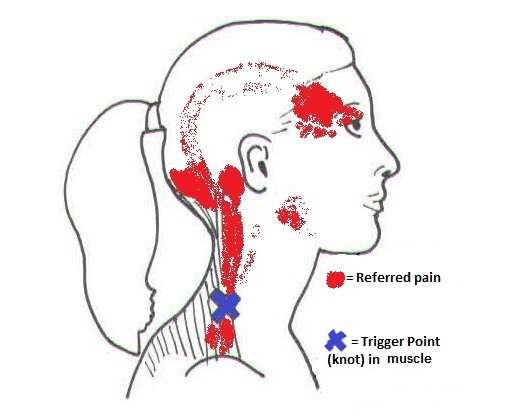
Trigger points are hyper-tight knots in taut bands of muscle that cause referred pain at a distance from their location. This works in a similar way to a crossed line on a telephone: a nerve ending from a muscle knot becomes so sensitised that it triggers a cross-over signal to a different nerve serving another part of the body. Common locations for tension headache trigger points are the trapezius muscles at the tops of the shoulders and the muscles at the base of the skull, producing characteristic pain along the sides of the head and toward the eye area.
How Manual Therapy Helps
Stretching and strengthening exercises help address underlying causes such as poor posture, but exercise alone usually isn't enough. In the same way that a cracked wall needs its faulty foundations repaired too, direct hands-on treatment is normally needed alongside exercise to release and relax the affected trigger points.
Trigger Point Massage takes considerable skill. It uses firm, slow, low-amplitude, sustained strokes with very little or no oil, applied in a way that stretches the taut muscle bands without irritating the over-active stretch receptors within the trigger points. Massage performed too fast, or without enough firm pressure on the muscle bands, can backfire: much like flicking a guitar string, it increases stretch-receptor activity and can leave trigger points, and the headaches they cause, worse than before.
Performed correctly, this reduces not only chronic muscle tension but also the oversensitivity of the nervous system seen in chronic tension headache sufferers and associated conditions such as Fibromyalgia, often allowing patients to reduce, or in some cases completely stop, muscle relaxant and neuropathic pain-modulating medication. Combining this with medical acupuncture usually enhances the treatment effect further.
The Role of Medical Acupuncture
Medical acupuncture takes a more scientific approach than traditional acupuncture, inserting a relatively small number of needles into trigger points identified through patient history and clinical assessment. Needles can access deep muscle bands unreachable by surface massage alone. Successful needle placement produces a distinctive "twitch response" followed by increased blood flow and trigger point relaxation. Millimetre-level precision is essential for optimal outcomes, making experience with this technique critical. If the twitch response isn't achieved on the first attempt, moving the needle just a millimetre or two can make the difference to a successful outcome.
Call us on 020 8506 1000 to discuss neck pain and headache treatment.